Building a Revenue Engine for a B2B Fintech

A pre-Series B fintech selling to credit unions and community banks had a product that worked and early customer traction. What it did not have was a repeatable way to turn that traction into predictable revenue.
There was no defined sales process, no qualification framework, and no pipeline to manage. Average annual deal size was $18K, and while there was an opportunity to build a partner channel, there was no structure behind it.
Over six months, Maven Advisory worked with the company to build the revenue function from the ground up.
The results
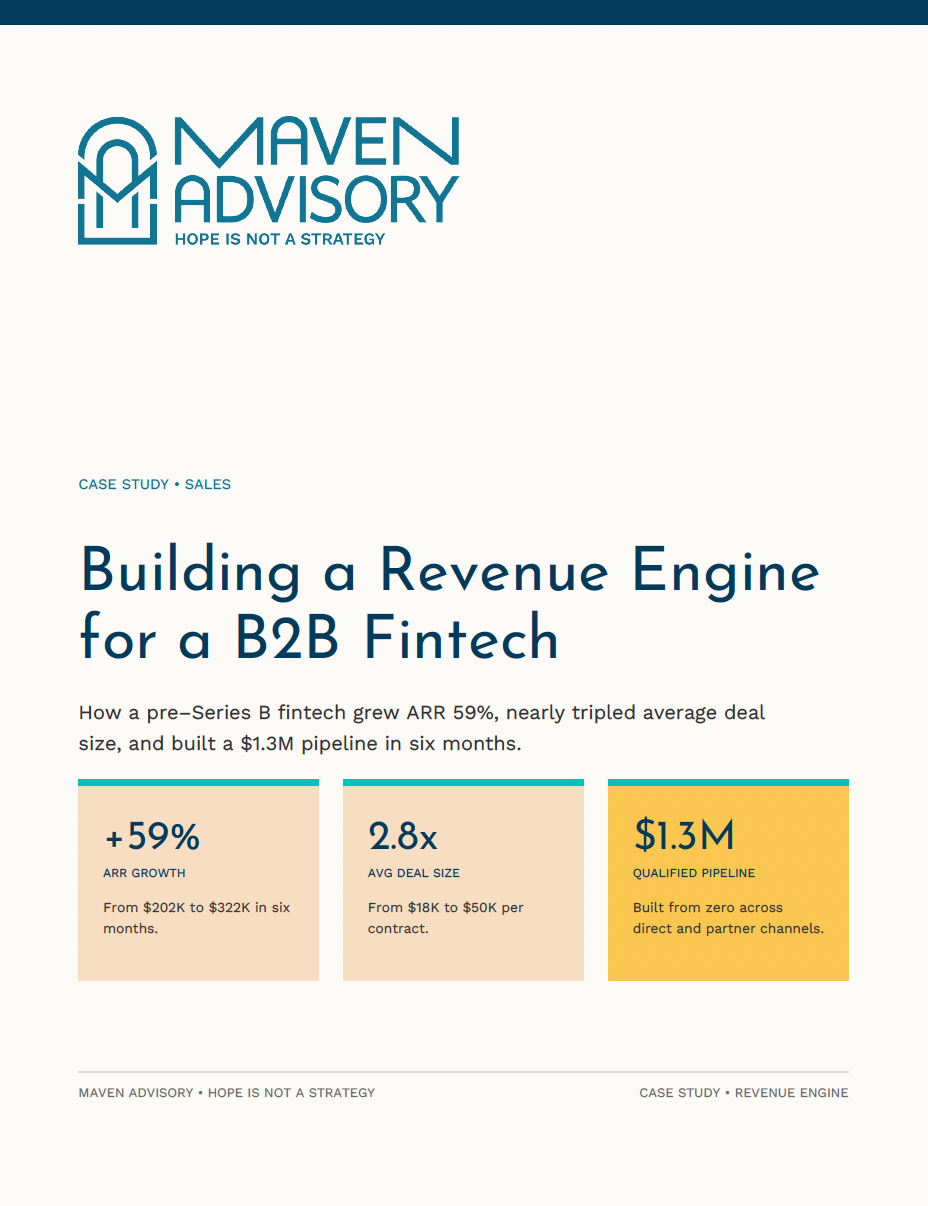
59% ARR growth
Annual recurring revenue increased from $202K to $322K.2.8x increase in average deal size
Average annual contract value increased from $18K to $50K.$1.3M qualified pipeline
A new pipeline was built across both direct and partner channels.
The company also closed five new deals across four credit unions and one bank and created a new partner-driven variable revenue stream running at approximately $5K per month.
The challenge
Demand was not the problem.
The fintech already had a viable product and customers. The challenge was that there was no system for converting demand into repeatable, forecastable revenue.
That meant pricing, qualification, pipeline management, channel strategy, and sales execution all needed to work together rather than being handled one deal at a time.
What Maven Advisory changed
We focused on three areas that would improve near-term revenue while giving the company a structure it could continue using as it grew.
Pricing
The pricing model was restructured to combine an annual platform fee, usage pricing, and a usage minimum.
The change gave the company a more predictable revenue floor while reducing the risk created by low-usage accounts and seasonal fluctuations. It also helped increase the average annual deal size from $18K to $50K.
Pipeline and partner channels
We built direct and partner pipelines in HubSpot and turned the partner channel from an idea into an active revenue channel.
For the first time, the company had clear visibility into which opportunities were qualified, where deals stood, and what was likely to close.
Sales process and qualification
We established a defined sales process and qualification framework so the company could spend its time on the right opportunities and forecast revenue more confidently.
Instead of relying on ad hoc selling, the company now had a repeatable process that could continue beyond the engagement.
What mattered beyond the numbers
The six-month results were significant, but the larger outcome was what remained in place afterward.
The company now had a pricing model, qualified pipeline, sales process, and partner motion designed to continue producing revenue rather than creating a one-time increase in bookings.
That matters when selling fintech into financial institutions because banks and credit unions do not buy like a typical B2B customer.
Maven Advisory brings experience from both sides of that process, including evaluating and buying fintech solutions inside financial institutions and leading revenue strategy for fintechs selling into them. That perspective shaped how the pricing, qualification process, and partner channel were built.
Read the full case study
The full case study goes deeper into the starting point, pricing changes, pipeline structure, qualification framework, partner strategy, and six-month results.

Angi Milano
Founder of Maven Advisory
Hope is not a strategy.